
Multiverse is a B2B enterprise learning platform, helping large organisations close critical skills gaps by upskilling their existing workforce, with a primary focus on AI enablement alongside data and engineering programmes.
The platform runs on a diagnosis-to-delivery model. Organisations are assessed to identify where upskilling returns the most value. Their employees are then assessed individually for suitability, matched to a programme, and taken through to delivery: async material, live workshops, group and 1:1 coaching, and applied on-the-job projects.
The surface I owned
The learner journey from sign-up and skills assessment through to programme recommendation, application, and platform onboarding, up to the day their programme starts.
The organisational diagnosis layer that determines which programmes a company's employees are eligible for in the first place.
Volume was the incentive. Fit was the outcome.
Multiverse is a sales led business, and the go-to-market team is heavily incentivised on the number of learners placed onto programmes. That incentive is rational and it funds the company. It also pulls in a different direction to learner success, and the seam between the two ran directly through my squad.
The symptoms were everywhere in the funnel. Learners were shown every programme they were technically eligible for, with no signal at all as to how well set up for success they'd be on any of them. The skills assessment asked questions that learners routinely misread, answering incorrectly and excluding themselves from programmes they were in fact well suited to. Fulfilment operations then unpicked those answers by hand, one learner at a time. Learners who did apply drifted in the weeks before their start date, with onboarding steps left incomplete, carrying compliance and revenue risk.
The squad sat between go-to-market, operations, people, learning science and compliance. A good deal of the role was translation, and a good deal of it was advocating for learner outcomes when commercial priorities pulled the other way.
Then the ground moved. Regulator feedback made learner retention the company's north star, and the argument I had been making on principle became the argument the business needed to win. Learners placed on badly matched programmes are precisely the learners who drop out. Fit was no longer the counterweight to growth. It was the mechanism for it.
A conduit, and a point of view.
I led design across the diagnosis and recommendation experience as the squad's Principal Product Designer, working end-to-end from long-term product vision to shipping tactical changes into production.Led product & design strategy
Set the product vision for the Diagnose and Prescribe streams, reframing their constituent systems as holistic agents
Defined the target state for the learner application and recommendation experience, and the iterative path towards it
Introduced the concept of programme alignment scoring, surfaced to both learners and customers
Ran research, prototyping, engineering handover, and shipped production changes directly
Held the line on learner outcomes across go-to-market, operations, learning science and compliance
Fix the signal. Then remove the friction.
The instinct in a volume-incentivised business is to widen the funnel. We did the opposite first: we made match quality visible, so that a learner and their employer could see not just whether they were eligible, but how well suited they actually were.
With that signal in place, everything else became a question of removing what stood between a well matched learner and their start date. Shorter assessments, questions people could actually parse, nudges that reminded them what was in it for them, and internal tooling that stopped operations doing by hand what the system should do itself.
●
ALIGNMENT SCORING
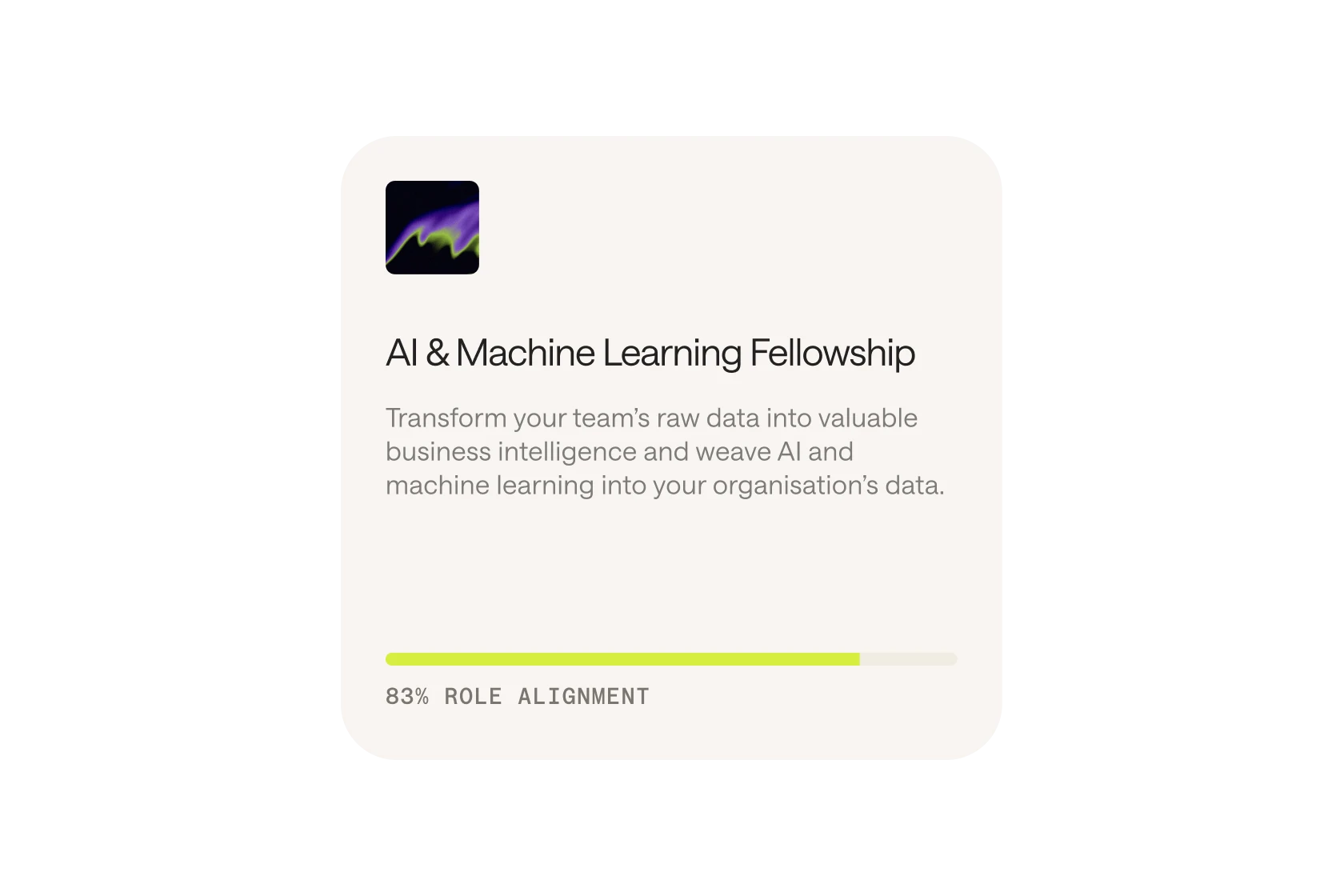
Match quality,
made visible.
Learners were previously shown every programme they were eligible for, with no indication of fit. Alignment scoring turned the skills assessment into a signal of how well set up for success each learner would be on each programme, played back to the learner making the choice and to the customer sponsoring it.
●
AI CAREER GUIDANCE
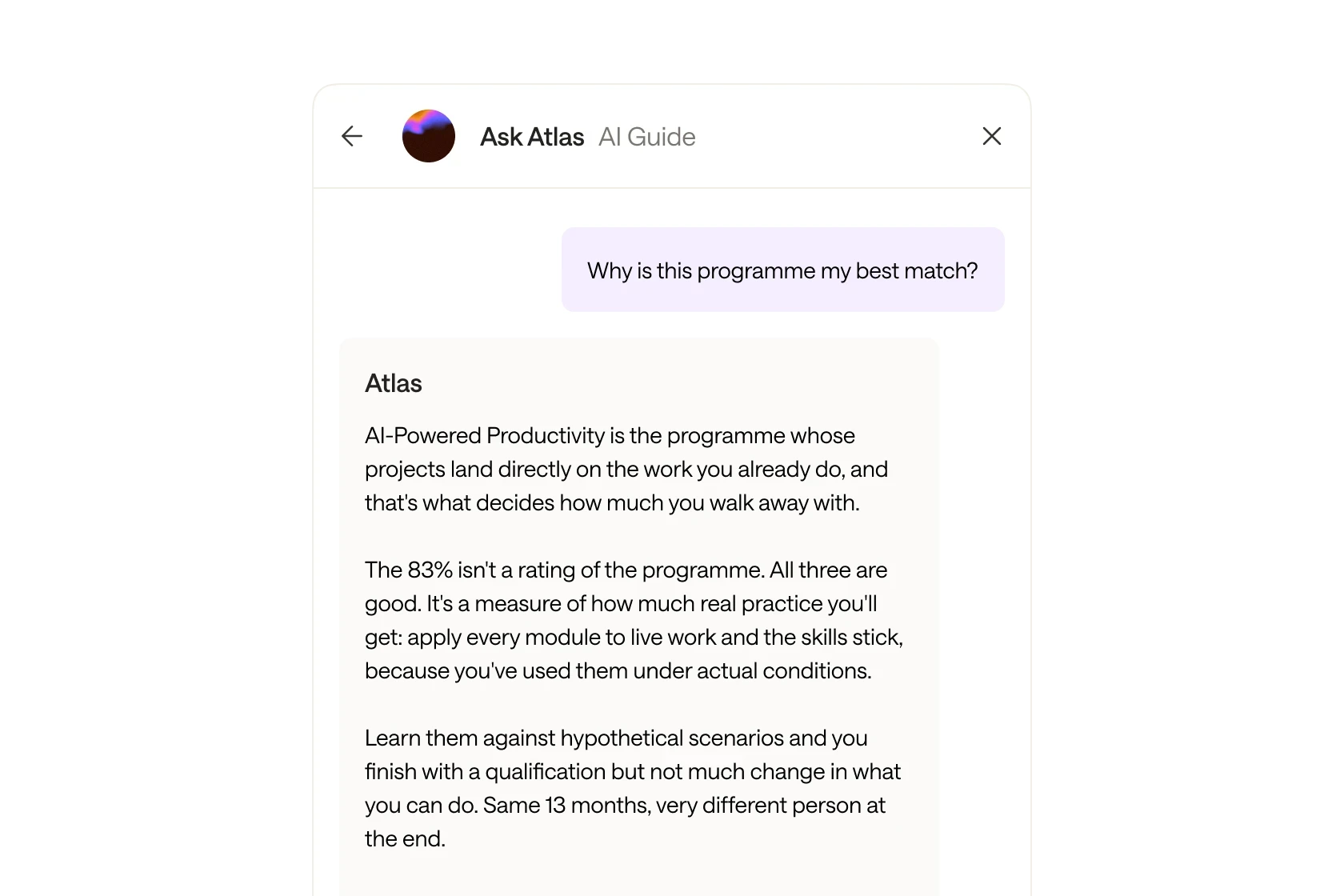
The right choice,
reasoned through.
Choosing a programme is the highest-stakes decision a learner makes on the platform, and the one they are least equipped to make alone. I defined how Atlas, Multiverse's AI learning guide, should enter that moment: a conversation the learner leads, synthesising their alignment scores, role and prior experience into a clear account of which programme fits, why it fits, and what it would unlock for their career. Reasoning they can question and pressure-test, rather than a recommendation they have to take on trust.
●
Assessment Experience

Fewer questions.
Better answers.
Branching and inference removed redundant questions by deriving answers from ones already given, cutting assessment length and drop-off. Alongside it, I identified and reframed the questions learners consistently misread, the ones causing them to wrongly exclude themselves from programmes they were suited to.
Behind the scenes, fulfilment operations had been overturning those incorrect answers manually, learner by learner. A self-serve internal tool put that capability directly in their hands, removing 47% of the manual hours spent processing applications.
●
Commitment & Onboarding

Momentum between
decision and day one.
A rebuilt drip email flow nudged learners through the application with reminders and reinforcement of what was in it for them. A simplified induction form and appropriately timed prompts closed the gap between application and start date, where retention, compliance and revenue risk all concentrate.
●
KEY BUSINESS OUTCOMES
Increase in learner application conversion
20%
sign-up to submitted application
Learner satisfaction, post-assessment
90%
up 30 points
Early uplift in first 3-month retention
~10%
the company's north star metric
Reduction in manual hours processing applications
47%
fulfilment operations, self-serve